

No products in the cart.

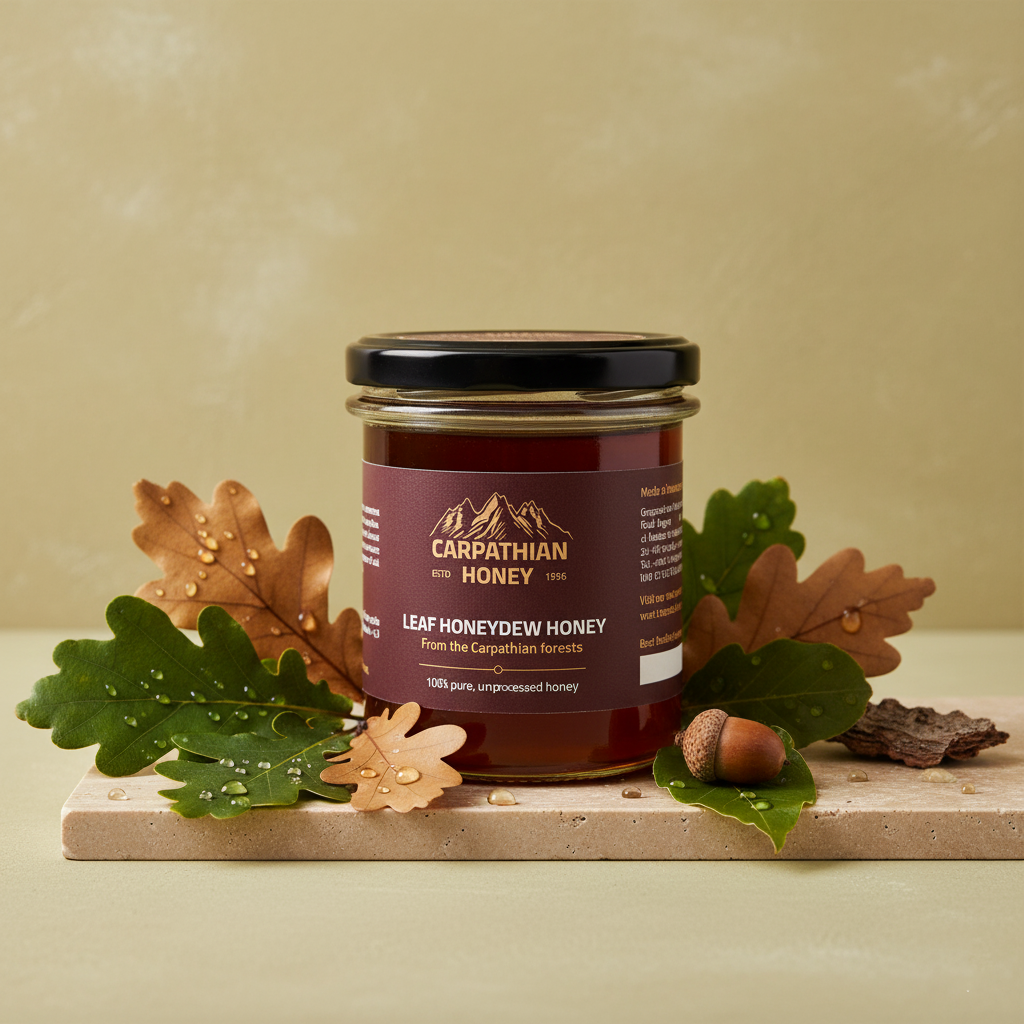
Leaf Honeydew Honey
€17,00
Color: various shades of brown
Taste: intense with a slightly spicy note
Aroma: intense, with distinct resinous and spicy notes
Crystallization: from several to several dozen months
Uses: supports metabolism, regulates heart function, lowers blood pressure, improves kidney function, and has a calming effect
Description
Deciduous Honeydew Honey – perfect for immunity and strengthening the body
What is honeydew and how is it formed?
The term honeydew refers to a sweet, sticky secretion that appears on leaves, needles, or shoots of trees and shrubs, produced as a result of the activity of aphids and scale insects (true bugs). Aphids and other insects suck plant sap (phloem), which contains mainly sugars (carbohydrates) and trace amounts of organic substances and mineral compounds. Because this sap contains more sugars than the insect needs, part of it is excreted as sticky droplets on the surface of leaves or shoots — this is honeydew.
Bees collect this honeydew (sometimes partially cleaning and concentrating it) and process it in the hive, similarly to nectar, producing honeydew honey.
There are several types of honeydew, including coniferous honeydew (from insects feeding on conifers such as spruce or fir) and deciduous honeydew (from deciduous trees: oak, linden, maple, beech).
Characteristics of honeydew honey: taste, appearance, crystallization
Appearance and color
Deciduous honeydew honey usually ranges in color from tea-like amber to dark brown. After crystallization, it becomes lighter, often turning brown. Compared to coniferous honeydew honey, it tends to be slightly lighter and less intensely colored.
Aroma and taste
Deciduous honeydew honey is characterized by a distinct, slightly resinous aroma with a spicy note and forest-herbal nuances. Its scent is intense with a mildly spicy note. In taste, it can be mild with a noticeable spicy note. It is perceived as less sweet — which results from a higher content of oligosaccharides (some of which taste less sweet) than in nectar honeys.
Why does honeydew honey crystallize more slowly?
Honeydew honey crystallizes much more slowly than nectar honeys (e.g., linden or multifloral). In some cases, it can remain liquid for many months — or even years. This happens for several reasons:
1. Different sugar composition
Honeydew honey contains more fructose than glucose. Glucose is responsible for crystallization — the more glucose, the faster the honey sets. Because fructose dominates in honeydew honey, crystallization takes place much more slowly.
2. Higher mineral content
Honeydew honey is rich in minerals, enzymes, proteins, and resinous compounds. These natural substances make its structure more complex, sticky, and dense, which also slows down the formation of glucose crystals.
3. Different origin – not from nectar, but from honeydew
Unlike nectar honeys, honeydew honey is not made from flower nectar, but from honeydew — a sweet secretion produced by insects feeding on coniferous or deciduous trees. This natural difference in origin translates into a different chemical composition that favors a longer-lasting liquid consistency.
4. Storage temperature
Honeydew honey stays liquid longer if stored at a stable room temperature (about 18–20°C). In a cooler place, it may crystallize faster, but still more slowly than most other honeys.
Fun fact
Slow crystallization of honeydew honey is a sign of its high quality and naturalness. Crystallization speed does not indicate whether honey is “better” or “worse” — it is a natural characteristic depending on composition. Even if honeydew honey remains liquid for a long time, it does not lose its nutritional and health benefits.
Vitamins, minerals, and active compounds
Micronutrient content — macroelements and trace elements
One feature that distinguishes honeydew honey (both deciduous and coniferous) is a much higher mineral content than nectar honeys. Literature indicates that the mineral content in honeydew honey can reach about 1% of its mass, whereas in nectar honeys it is usually around 0.1–0.2%.
Key macro- and microelements found in honeydew honeys include: potassium, calcium, magnesium, manganese, and iron.
In addition, honeydew honey contains proteins and free amino acids (about 5% of its composition), which is roughly twice as high as in nectar honeys. Among the amino acids, tryptophan has been identified — essential for neurotransmitter synthesis in the brain.
Biologically active compounds: phenols, flavonoids, organic acids
One of the most valuable features of honeys (both nectar and honeydew) is the presence of phenols, flavonoids, and organic acids, which contribute to antioxidant, anti-inflammatory, and antimicrobial effects.
Health properties and benefits
Honeydew honey is known for a range of health-promoting effects attributed to its vitamins, minerals, and active compounds.
Anti-inflammatory and antioxidant effects
Thanks to phenols and flavonoids, honeydew honey helps reduce oxidative stress and inflammatory processes in the body.
Antimicrobial / antibacterial activity
It shows bactericidal activity (including against Staphylococcus-type bacteria) — even at low concentrations.
Respiratory support
Honeydew honey is used for respiratory conditions (cough, colds, bronchitis) due to its expectorant, anti-inflammatory, and antibacterial properties.
Support for the heart and cardiovascular system
Thanks to antioxidant properties and trace elements (e.g., potassium, magnesium), honeydew honey supports circulation, may help widen blood vessels, regulate blood pressure, and support lipid balance.
Regeneration and recovery
Due to its rich nutritional and enzymatic composition, honeydew honey is often used after illness, surgery, or in deficiency states — helping rebuild strength.
Detoxifying effect
In traditional natural medicine, honeydew honey has been used to “detox” the body from the effects of alcohol, tobacco, coffee, and other toxins.
Urinary tract support
Deciduous honeydew is attributed diuretic, antispasmodic, and anti-inflammatory effects, which may support kidney filtration and help with urinary tract inflammation.
Digestive support
Honeydew honey is sometimes used for digestive issues: it can soothe inflammation of the gastrointestinal mucosa, support healing of irritations and ulcers, and help maintain gut microbiological balance.
Who is honeydew honey for?
Children
Honey is not recommended for children under 1 year of age (due to the risk of botulism). After 1 year, in moderate amounts, honeydew honey can be used as a natural addition to drinks and as immune support.
Older adults
For seniors, honeydew honey may be a valuable supplement due to its trace elements, antioxidant effects, and support for circulation and heart function.
Physically active people
For those who train or live an intense lifestyle, honeydew honey can be a source of quick energy (simple sugars) combined with nutritional value (trace elements, enzymes). Additionally, its anti-inflammatory effect may support recovery.
Is honeydew honey good for allergy sufferers?
Honeydew honey may be well tolerated by many people with allergies because — unlike nectar honeys — it does not come directly from flower pollen, but from honeydew.
However, this does not mean it is completely safe for all allergy sufferers. In very sensitive individuals, a reaction may occur due to trace amounts of pollen or bee proteins. Therefore, it is worth:
- trying a small amount (e.g., half a teaspoon) and observing your body’s reaction,
- choosing honey from a trusted, local source (preferably from a single apiary).
Thanks to its anti-inflammatory and antioxidant effects, honeydew honey may reduce symptoms of seasonal allergies such as runny nose, cough, or irritated mucous membranes. Some people also notice that regular, moderate consumption of local honey helps reduce sensitivity to pollen (a so-called desensitization effect).
Where does the honeydew honey from our apiary come from?
Honeydew honey from our apiary is a unique product made in the heart of pristine nature — in mountainous and forest areas, far from industry and monoculture farming.
Our apiaries are located near vast forests dominated by spruce, fir, beech, oak, maple, and linden trees.
Depending on the year and weather conditions, bees collect both coniferous honeydew (from spruces and firs) and deciduous honeydew (from lindens, oaks, maples, or beeches). As a result, our honeydew honey may vary in color and aroma, but it always retains an intense, resinous taste and a dark color with a slight greenish tint — characteristic of true honeydew honey.
The places our honey comes from are ecologically clean and far from sources of pollution. The absence of industry gives bees access to a healthy, natural environment.
Behind every jar are more than 30 years of beekeeping experience and care to harvest honey at the perfect moment — when it has full nutritional value and aroma.
FAQ — frequently asked questions
1. Is honeydew honey better than nectar honey?
In terms of mineral content and health benefits — yes. Honeydew honey contains more trace elements and has stronger anti-inflammatory and antioxidant effects. However, nectar honeys are milder in taste and often better tolerated by children.
2. How can you recognize real deciduous honeydew honey?
It has a dark color, a thick consistency, and an intense, slightly resinous aroma. It often crystallizes slowly. In taste, it is less sweet than floral honeys, with a noticeable forest note.
3. Can honeydew honey be used in a daily diet?
Yes, it is worth consuming daily in moderate amounts (1–2 teaspoons). It supports immunity, improves heart and digestive function, and supports recovery.
4. How many calories does honeydew honey have?
Like other honeys — about 300–330 kcal per 100 g (depending on composition). Honey is mainly made up of simple sugars and oligosaccharides.
5. Can honeydew honey be harmful?
Not if consumed in moderation. It should not be given to children under 1 year of age. People with diabetes should be cautious due to the content of simple sugars.
6. Can honeydew honey be used for seasonal allergies?
Yes, honeydew honey may relieve allergy symptoms thanks to its anti-inflammatory action. It contains fewer pollen allergens, so it is often better tolerated by allergic individuals.
7. When is the best time to consume honeydew honey?
Ideally in the morning on an empty stomach, dissolved in lukewarm water, or in the afternoon to replenish energy. Do not add it to hot drinks above 40°C.
8. Is honeydew honey good for athletes?
Yes. It is a natural source of energy and minerals. It supports recovery after exercise and improves overall performance.
9. Is honeydew honey good for people with diabetes?
Compared to most nectar honeys, honeydew honey has a lower glycemic index (GI approx. 45–55) and contains more oligosaccharides and mineral compounds, which makes its impact on blood sugar somewhat milder. However, this does not mean it is fully safe for diabetics.

Reviews
There are no reviews yet.